Every strata scheme has the same problem in a different building: the asset list lives in a contractor's head or a spreadsheet nobody owns, the certificates are in an inbox, and the question at the AGM is whether the fund will cover what is coming. The answer starts with knowing what the scheme owns.
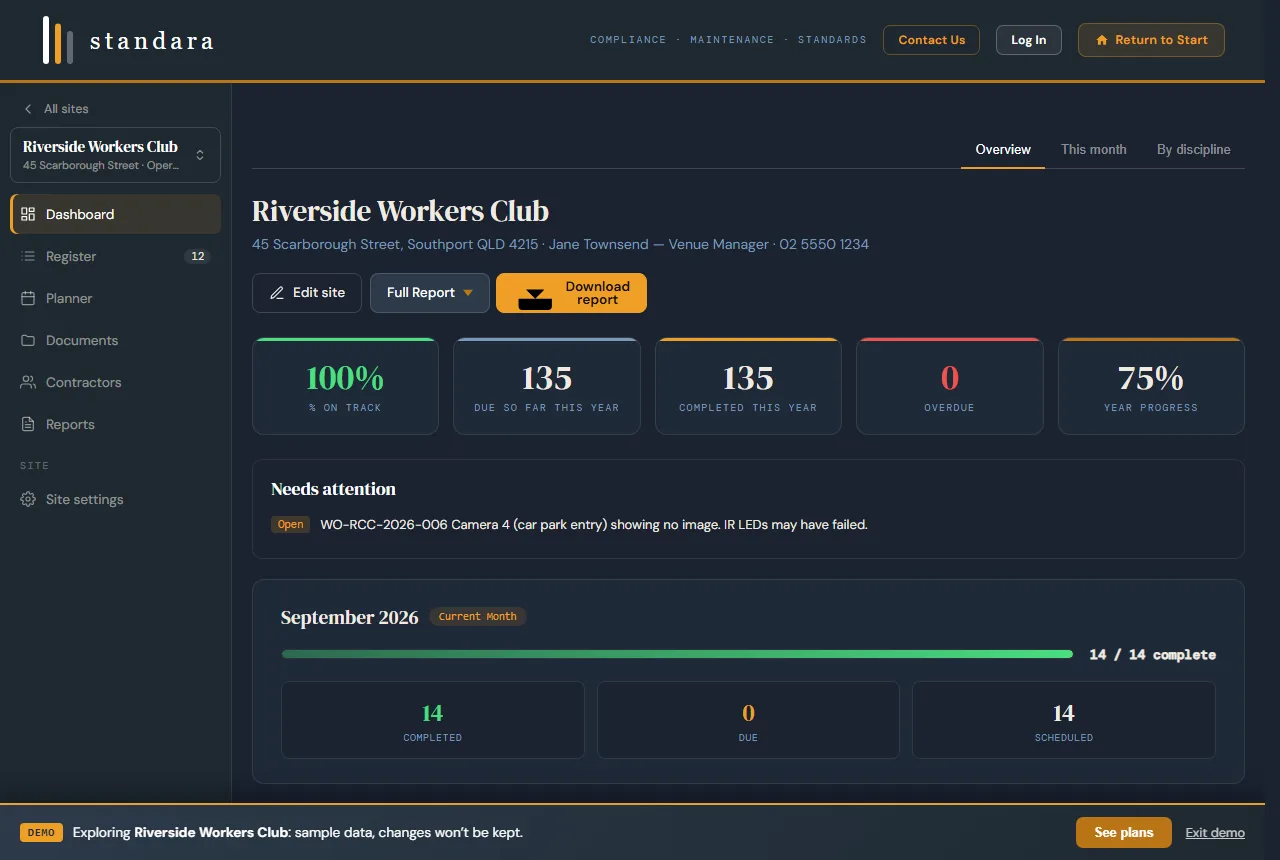
The dashboard a committee can read: on-track status, what is due, what is overdue. Demo data.
What common property has to maintain
- Fire and life safety: detection and alarm systems, extinguishers, hydrants and hose reels, sprinklers, fire doors, emergency and exit lighting
- Vertical transport: lifts and platform lifts
- Hydraulic: pumps, backflow prevention devices, hot water plant, thermostatic mixing valves, stormwater and sewer pumps
- Mechanical and electrical: car park ventilation, air handling for common areas, switchboards, RCD testing, emergency generators
- Access and fabric: gates and garage doors, access control and CCTV, roof, facade, waterproofing, balustrades, pools and gym equipment where the scheme has them
Each carries a governing AS/NZS standard and a service frequency. The scheme's obligation is to keep the common property in good repair; the register is how a committee shows it has.
What the register gives a strata manager
Each scheme is a site with its own register, 12-month planner, contractors and documents. A manager with a portfolio holds each separately and reports on each separately.
A new committee opens the same dashboard the last one used: what is due, what is overdue, what was done, and where the certificate is. Nothing has to be re-explained.
In New South Wales the annual fire safety statement, in Queensland the occupier's statement: the practitioner needs the service history for every fire safety measure, and the planner holds it.
A 10-year capital works fund plan in New South Wales, a sinking fund forecast in Queensland: both start from a list of what the scheme owns and when it will need replacing. The register is that list. A Capture engagement adds condition, expected useful life and replacement cost on the same assets.
How Standara does it for a scheme
- Register. Select the scheme's common property assets from 78 types across 11 disciplines, or paste the existing list. Each carries its governing standard and its tasks.
- Planner. The 12-month schedule is generated from the register. Mark visits complete as contractors attend; overdue items rise to the dashboard and the monthly picture.
- Contractors. One per discipline, with licence and insurance cover on file and their scope of works in writing for the next tender.
- Callouts. The reactive log for the gate motor and the lift, with a work order reference, cost and status, so the committee sees planned and reactive spend on the same asset base.
- Documents. Certificates, test reports and photos filed by discipline.
- Reports. The summary report for the committee meeting, the full compliance report for the insurer and the practitioner, the schedule as Excel for the contractors.
New buildings and handover from the developer
A scheme that takes over a new building at Practical Completion inherits the commissioning record, the warranties and the defects. On the Professional plan the project starts in the commissioning module during construction, and at handover the commissioned systems become the scheme's register with the maintenance schedule starting from the handover date. The defects liability period is tracked in the same place.
Prefer it built for you?
Standara Capture is the done-for-you path: a practising facilities manager walks the common property, captures every maintainable asset with a nameplate photo, builds the standards-mapped register and the planner, and hands it over live in Standara. Where the committee is planning capital works, the same walk adds condition ratings, expected useful life, replacement costs and a 10-year capital forecast. Fixed quote after a short scoping call, servicing NSW and South-East Queensland. Request a scoped quote.
Pricing
Prices in Australian dollars, plus GST. Standard is $149 per month or $1,489 per year for one scheme. Professional is $399 per month or $3,999 per year for up to three schemes, with team members, the callout log, documents and the commissioning module. Enterprise covers a strata manager's full portfolio by quote. Compare the plans.
Common questions
What is a strata maintenance schedule?
The recurring servicing of the common property assets the scheme is responsible for, each with its governing AS/NZS standard and frequency, laid out as a 12-month calendar generated from the register.
Does a strata scheme count as one site?
A single scheme with shared services usually counts as one site. A strata manager with several schemes holds each as its own site and reports on each separately.
Can it feed the capital works fund plan?
The register is the starting point, because it lists what the scheme owns. A Capture engagement adds condition ratings, expected useful life, replacement costs and a 10-year capital forecast on the same asset base.
Related
- Facility management software for Australian buildings: the whole system for one to three sites.
- AS 1851 maintenance schedule: what has to be serviced, how often, and the records a building owner has to keep.
- Electrical testing schedule: how often RCDs, plug-in equipment, switchboards and emergency lights are tested, and which rule sets each interval.
- How to build a facilities asset register: what to capture on the site walk, with a free template.
- Clubs: the same register for a licensed club.