Riverside Workers Club, a two-storey licensed workers club built in 2008, Class 9b under the National Construction Code: main bar, lounge bar, gaming room, commercial kitchen, bistro, function spaces and an outdoor terrace. One venue manager, a small staff, and every discipline of building services under one roof. The club, its venue manager and every contractor named below are invented for the demonstration; the assets, tasks, intervals and standards references are the real library entries a club of this kind carries.
1. What the club owns: the register
The register was built by picking from Standara's library the twelve things the building has. Each entry arrived with its discipline, its governing standard and its tasks already attached, so the register and the planner were done in the same sitting.
| Discipline | Asset | Recurring tasks |
|---|---|---|
| Fire and life safety | Emergency exit and escape lighting | Monthly function test (recommended), six-monthly discharge test, commissioning test after any change |
| Fire and life safety | Fire indicator panel | Monthly inspection, annual test of every device, five-yearly extended routine |
| Fire and life safety | Portable fire extinguishers | Monthly walk (recommended), six-monthly service, annual examination, five-yearly pressure test |
| Fire and life safety | Fire hydrant and hose reel system | Monthly walk (recommended), six-monthly service, annual flow test, five-yearly booster and hydrostatic test |
| Fire and life safety | Smoke detection and alarm system | Monthly check (recommended), annual test, ten-yearly detector replacement |
| Mechanical and HVAC | Split system air conditioning | Monthly filter check, quarterly service, six-monthly outdoor unit clean, annual full service |
| Electrical | Switchboard and distribution boards | Monthly walk, annual service, annual thermal scan |
| Electrical | RCD safety switches | Monthly push-button test (recommended), annual operating-time test (recommended) |
| Hydraulic and plumbing | Gas storage hot water system | Monthly temperature check, six-monthly relief valve, annual service, anode at three to five years |
| Vertical transport | Passenger lift | Monthly service and phone test, six-monthly inspection, annual inspection and certificate |
| Security and access | CCTV system | Monthly check, six-monthly service, annual review |
| Structure and fabric | Roof and guttering | Six-monthly clean and inspection (quarterly under trees), annual inspection, check after storms |
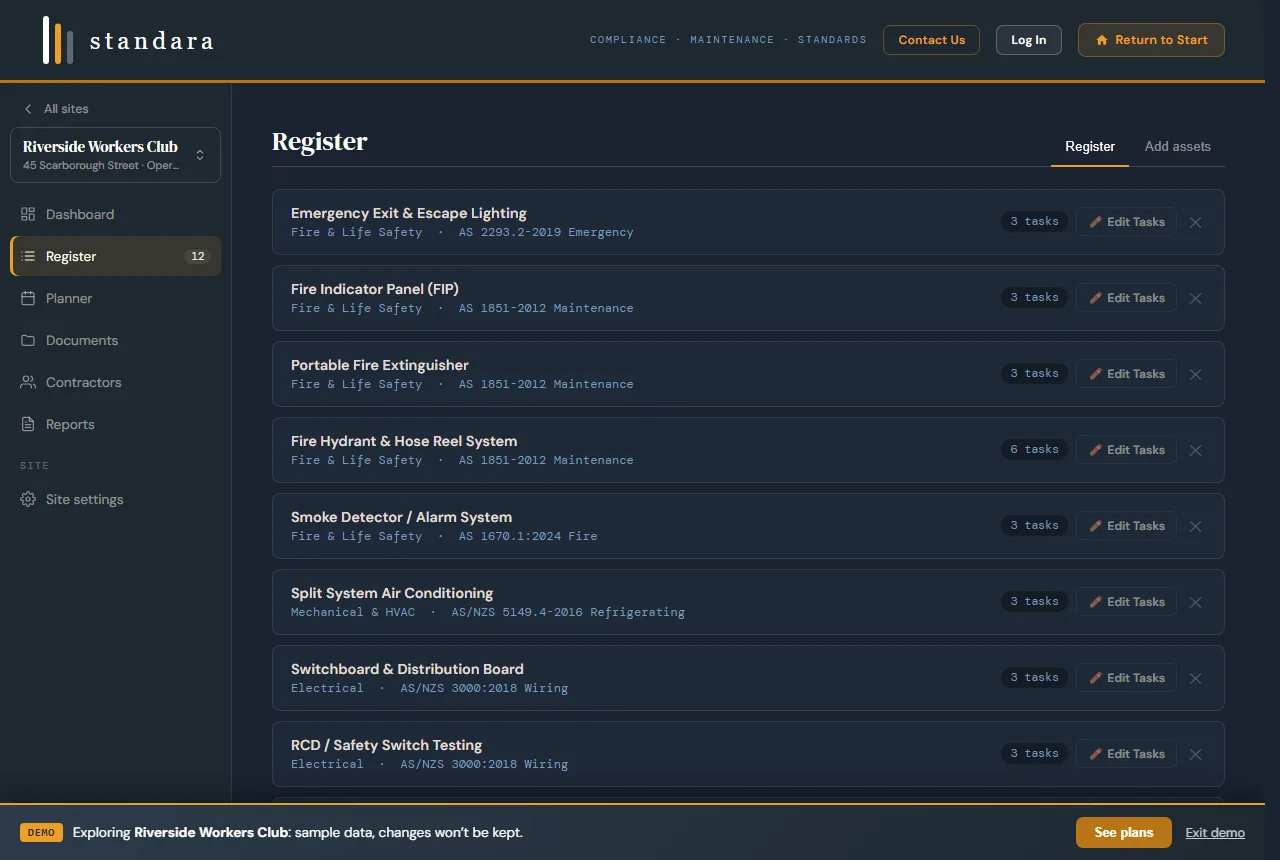
The register: twelve assets, each with its discipline, standard and task count. Demo data.
What is deliberately not on the list matters too. The club has no cooling tower, no sprinklers and no backflow device on the register, so the planner carries none of their tasks. A register that lists what the building actually has is the whole point; a template that lists everything a club might have produces a planner nobody follows.
2. The year: the planner
Fifty-three recurring tasks produce 184 scheduled visits or checks across the twelve months. Eleven of the tasks are monthly owner checks: the emergency lighting test switch, the panel indicators, the extinguisher and hydrant walk, the smoke detection check, the split system filters, the switchboard walk, the RCD push button, the hot water temperature, the lift phone test call and the CCTV check. They cost nothing but a walk and a pen, and they are the checks that find the wedged fire door and the dead exit sign between contractor visits.
The rest are contractor visits: the fire services contractor twice a year with a fuller annual visit, the air conditioning contractor quarterly, the electrician, plumber, lift company and security company once or twice a year, the roof contractor twice, and the five-yearly and ten-yearly items that fall in whatever year they fall. The planner places each one in a month, and the same task lands in the same month every year, so the fire contractor's six-monthly visit is in the same two months of every year the club owns the building.
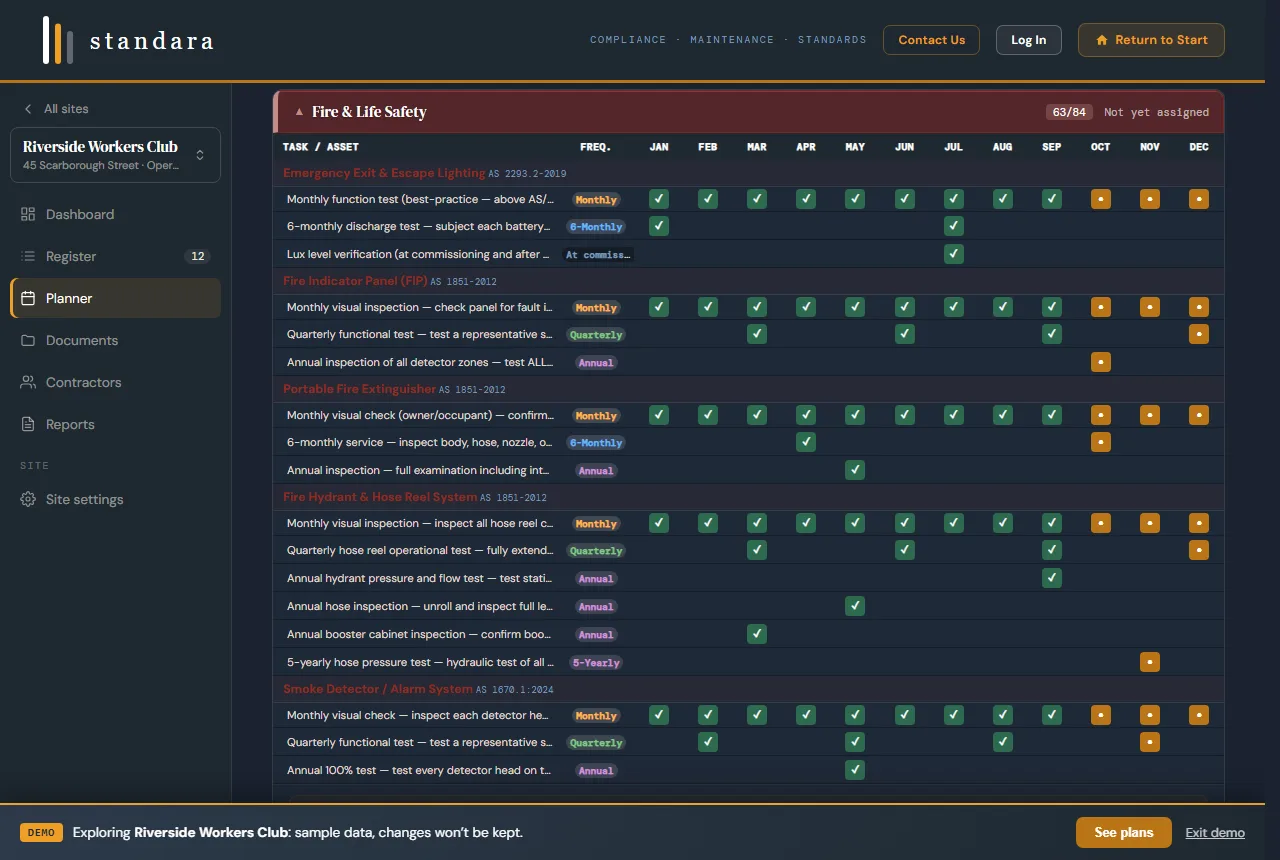
The planner: one row per task, twelve months across, scheduled and completed cells. Demo data.
3. A month in the life
Open the dashboard in any month and the to-do list is the month's scheduled items, overdue ones first. In a typical month that is the eleven owner checks plus whatever the quarterly, six-monthly and annual cycles have dropped in: in a six-monthly month the fire contractor's visit, the hot water relief valve, the lift inspection, the CCTV service and the roof clean all arrive together, and the venue manager books them in one round of calls. Each item is marked done from the list, with the date and who attended, and the completion count on the dashboard moves.
The dashboard's on-track figure is the year's completed items against the items due so far. Behind it sits the needs-attention list: anything scheduled in a past month and not marked done, and any callout still open. At the time of writing the demo sits with most of the year's checks complete and a handful outstanding, which is what a well-run building looks like in September.
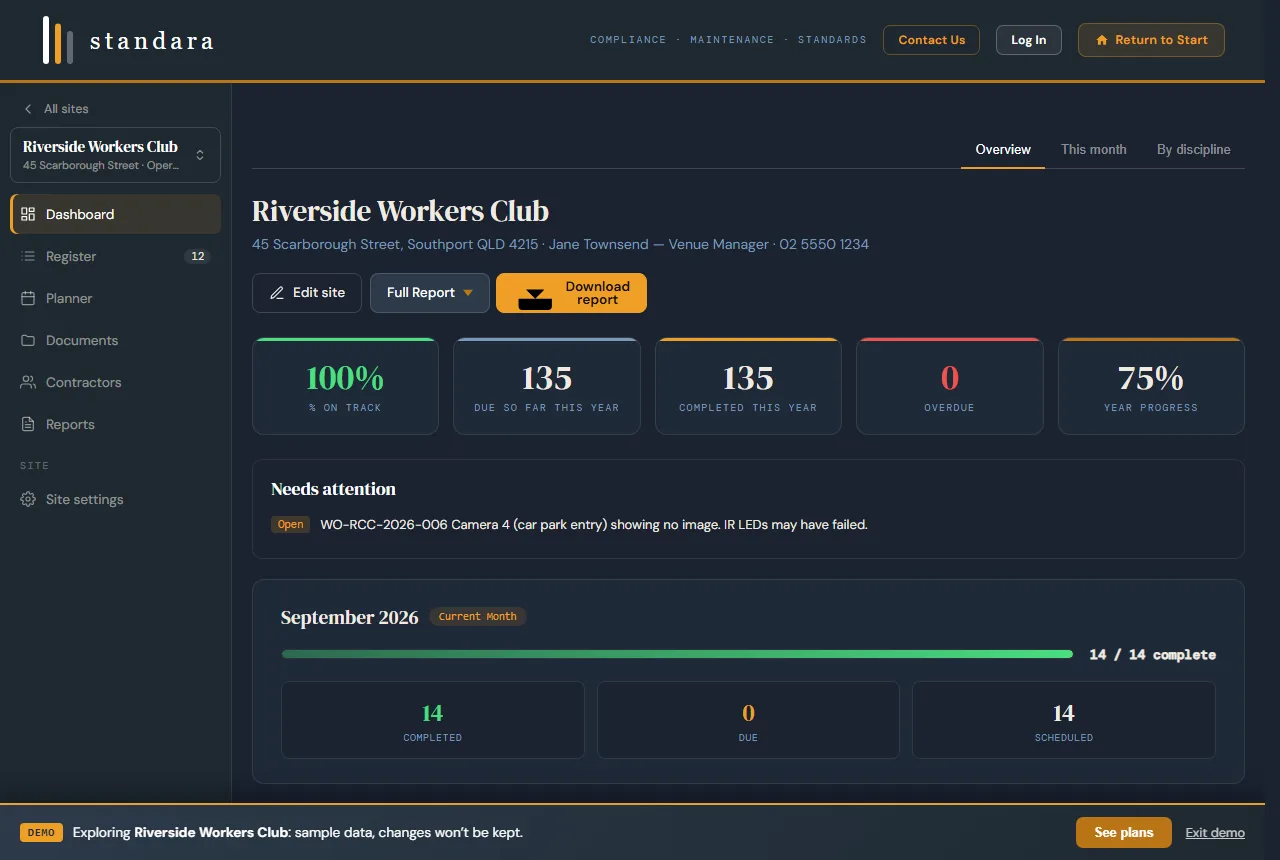
The dashboard: on-track percentage, due and completed, overdue and the needs-attention list. Demo data.
4. When something breaks: the callouts
Six callouts in the first quarter, five closed and one open, logged against the asset they concern so the history stays with the asset. The contractor names are invented.
| Date | Asset | What happened | Contractor | Cost |
|---|---|---|---|---|
| 14 January | Switchboard | Main hall lights flickering intermittently, reported by staff during the morning session. | Tamsbury Electrical Co | $385 |
| 28 January | Hot water | No hot water to kitchen and amenities; tempering valve failure suspected. | Corrindale Plumbing | $620 |
| 5 February | Split system | Meeting room 2 unit not cooling, error code E4 displayed. | Verrowby HVAC Group | $275 |
| 19 February | Fire doors | Ground floor stairwell B fire door not latching; self-closer fatigued. | Harrowgate Fire Services | $440 |
| 10 March | Lift | Lift stuck between ground and level 1 with passengers; manual release required. | Wintermere Lift Co | $1,850 |
| 22 March | CCTV | Camera 4 at the car park entry showing no image; infrared LEDs may have failed. Open, no contractor assigned yet. |
Three thousand five hundred and seventy dollars of reactive work in a quarter, which is the number the board asks about. Two of the six were found by a person noticing something (the flickering lights, the dead camera); two were failures the planner's tasks exist to prevent (the fire door closer, which the monthly walk is meant to catch, and the tempering valve, which the annual service covers). The lift entrapment is the reason the monthly phone test is on the list. A callout that recurs three times in twelve months is flagged on the asset, and a callout over the approval threshold waits for a sign-off before it is dispatched.
5. What the board, the auditor and the insurer see
Three documents come out of the same data, from the Reports page, without anyone retyping anything.
- The summary report, two to three pages for the board: discipline status, completion to date, overdue items and open callouts. The venue manager attaches it to the monthly board pack.
- The full compliance report, every asset, task, frequency, governing standard reference and completion for the year. This is the document handed to the fire authority, the insurer at renewal or an auditor, and the record behind whatever annual fire safety declaration the state requires of the occupier.
- The planner exports, the same schedule as an Excel workbook or CSV, sent to each contractor so their visits are in their diary in the same months they are in the club's.
For a club planning its own capital works, the same register exports as a ten-year capital works workbook in the categories of the NSW standard form, with the projected replacement years filled in where a Capture engagement has recorded condition and age.
6. What it took
Site details, twelve assets picked from the library, contractors named against each discipline, and the planner reviewed once for the months that suited the club: about an hour for a building this size. The monthly checks take the venue manager a walk of the building with the to-do list open. The rest is the contractors turning up in the months the planner says, and someone marking the visit done. The register is the work; everything else follows from it.
Related
- Maintenance software for clubs: the kitchen, cellar, gaming and pool assets a club has to keep on schedule.
- How to build a facilities asset register: the register this example starts from.
- AS 1851 maintenance schedule: the fire protection intervals behind five of the twelve assets.
- How often should fire extinguishers be serviced? and the other short how-often answers.
- Do I need a CMMS?: why a club this size runs a planner, not a work-order system.
Twelve assets, a year of checks in the right months, six callouts with their history, and three reports from one set of data. That is the whole system, and the demo is the same site you have just read about.